
Welcome to atto-nano science!
Josef Tiggesbäumker and Karl-Heinz Meiwes Broer
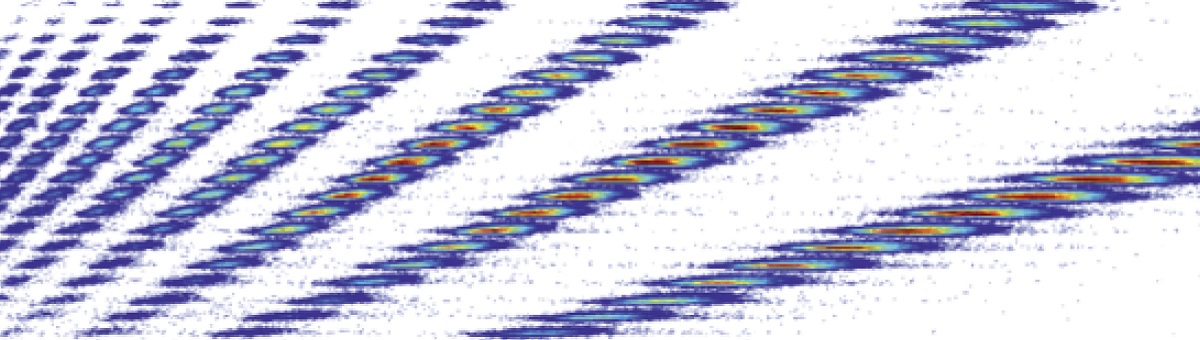
Our main field of research is the investigation of clusters, i.e. of particles as small as only a few nanometers, or even less. Such small particles are benchmark systems for nanostructured materials and offer the unique chance to explore the development of many-body phenomena in finite quantum systems. We study the properties of free atomic clusters and complexes embedded in ultracold helium droplets, with a special focus on the interaction between light and matter, ranging from electron emission up to ultrafast nonlinear dynamics in nanoplasmas. Read more...
Recent Highlights
Ion Recoil Energy Signatures of Geometric Shells from the Coulomb Explosion of Size-Selected Silver Clusters
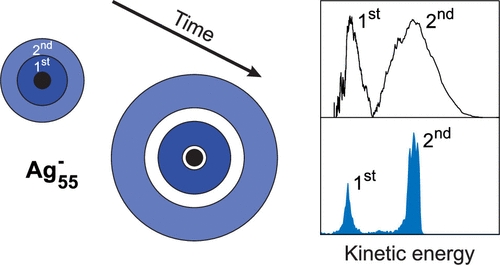
The strong-field dynamics of laser-produced nanoplasmas generated from free and size-selected silver clusters, AgN–, are analyzed by charge-state-resolving ion recoil energy spectrometry. Targeted excitation of the plasmon resonance increases the plasma electron temperature, which has an effect on ion screening, electron–ion recombination, and correlated decay. By minimizing these complex contributions to the ion expansion through plasmonic energy uptake, pronounced peaks show up in the ion recoil energy spectra, which can be assigned to the emission of ions from different geometrical shells reflecting the initial cluster structure. The feature becomes particularly pronounced upon reaching the icosahedral shell closing at a cluster size of N = 55. A signature of geometrical shells is also observed for Ag147–, which underpins the scalability of the approach via plasmon-assisted control of the nanoplasma dynamics.
Transition from surface to volume expansion in argon clusters Coulomb explosion
The intensity-difference spectrum technique is applied to record charge-state resolved ion energy spectra from the Coulomb explosion of small Ar clusters under well-resolved laser intensity conditions. The far-reaching control of the experimental parameters permits us to identify a striking change in the expansion pattern of the nanoplasma beyond a given intensity. The simultaneous characterization of ion charge state and energy uncovers that a reduction of the laser intensity leads to a development of low energy cuts in the ion yields, not present at higher fluence. The complex interplay of outer ionization, recombination, ion screening, and the phenomenon of ionization saturation favors a surface-driven expansion at low plasma electron temperatures. With increasing laser intensity a transition into a volume-driven Coulomb explosion is observed.
Metal cluster plasmons analyzed by energy-resolved photoemission
The optical response of size-selected metal clusters is studied by wavelength-dependent photoemission and energy-resolved photoelectron detection. Relative photodetachment cross sections giving information on the plasmon are determined for the example of closed-shell Ag91−. Notably, the peak energy of this anion (3.74 eV) is higher than the small particle limit in Mie theory of 3.5 eV. Different methods to extract cross sections from the spectra are applied. In particular, we compare the results obtained by integrating the full electron yields to analyses based on evaluating specified binding energy windows. The approach opens up new possibilities to conduct studies on Landau fragmentation as a result of multielectron excitations.
Phase-of-the-phase electron momentum spectroscopy on single metal atoms in helium nanodroplets
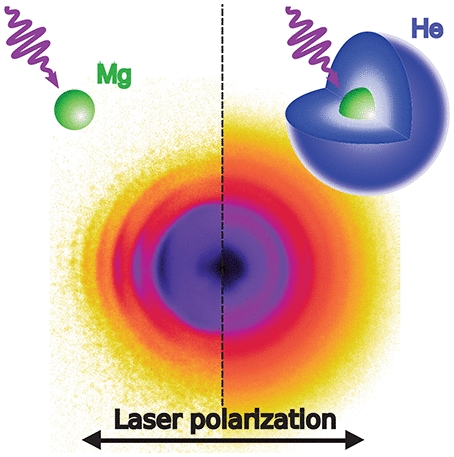
Magnesium atoms fully embedded in helium nanodroplets are exposed to two-color laser pulses, which trigger multiphoton above-threshold ionization (ATI). This allows exemplary study of the contribution of a dense, neutral, and finite medium on single electron propagation. The angular-resolved photoelectron spectra show striking differences with respect to results obtained on free atoms. Scattering of the individual Mg photoelectrons, when traversing the neutral helium environment, causes the angular distribution to become almost isotropic. Furthermore, the appearance of higher-energy electrons is observed, indicating the impact of the droplet on the concerted emission process. Phase-of-the-phase spectroscopy, however, reveals a marked loss in the 2ω–ω phase dependence of the electron signal. Taking into account sideband formation on a quantitative level, a Monte Carlo simulation which includes laser-assisted electron scattering can reproduce the experimental spectra and give insights into the strong-field-induced electron emission from disordered systems.